
The Most Important Machine in the World (And Why Europe Built It)
TL;DR
ASML's EUV lithography machine is the most complex device ever built by humans. It costs $380 million, weighs 180 tons, and is the only way to manufacture advanced chips. Without it, there's no AI revolution. And here's the thing - it's European technology that nobody can copy. Not China. Not anyone.
A Conversation About Power
I was chatting with a couple of colleagues the other day. We talked about AI, about Europe's place in the tech world, about geopolitics. The usual doom and gloom about how America has the software, China has the manufacturing, and Europe has... regulations?
Then someone mentioned ASML. The most important machine in the world, they said. Built in Veldhoven, a small Dutch town of 45,000 people. Without it, the entire global tech industry stops.
We went down the rabbit hole together, piecing together just how insane this machine actually is. Most people have never heard of it. But once you understand what ASML does, you can't unsee it.
What Is This Machine?
ASML makes lithography machines. That sounds boring until you understand what lithography actually means.
Every chip in every device you own was created by shining light through a pattern onto silicon, like a photograph. The smaller you can make those patterns, the more transistors you can fit on a chip. More transistors means more computing power.
The problem? We ran out of ways to make light small enough.
Regular light has a wavelength of about 193 nanometers. Modern chips need features smaller than 7 nanometers. The math doesn't work. You can't use a paintbrush to draw details finer than the brush itself.
ASML's solution was to use a different kind of light entirely. Extreme Ultraviolet light. EUV. With a wavelength of just 13.5 nanometers.
But here's where it gets insane.
The Machine That Shouldn't Exist
EUV light doesn't exist naturally. You have to create it. Here's how:
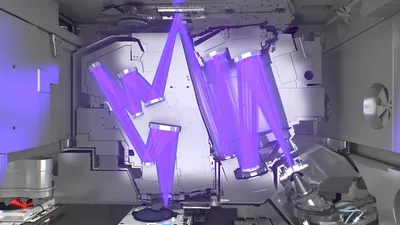
A laser fires 50,000 times per second at tiny droplets of molten tin, each droplet just 25 micrometers across. The laser hits the droplet twice - once to flatten it, once to vaporize it into plasma. That plasma emits EUV light.
This happens 50,000 times per second. The accuracy required is like hitting a golf ball with another golf ball, in mid-flight, from a kilometer away. Every 20 microseconds.
But that's not even the hard part.
EUV light is absorbed by everything. Air absorbs it. Glass absorbs it. You can't use lenses. The entire optical path has to be mirrors, in a near-perfect vacuum. These mirrors are made by Zeiss in Germany - each one polished so precisely that if you scaled one up to the size of Germany, the largest bump would be one millimeter tall.
The machine has 100,000 parts sourced from 5,000 suppliers. It takes four 747 cargo planes to ship one. Assembly takes a year. It costs $380 million.
And ASML is the only company on Earth that can build it.
Why Can't Anyone Copy It?
China has poured billions into developing their own EUV machines. They've acquired technical knowledge through various means. They have brilliant engineers.
They still can't build one.
It's not one technology - it's thousands of them, all at the bleeding edge, all having to work together perfectly. The laser system comes from TRUMPF in Germany. The optics from Zeiss. The vacuum systems, the motion control, the software that coordinates it all - each piece represents decades of specialized expertise.
The Supply Chain is the Moat
Zeiss (Germany)
Makes the mirrors. 40 years of optical expertise. Nanometer-level precision. No alternative supplier exists.
TRUMPF (Germany)
Makes the laser system. 20 kilowatts of precisely controlled power, 50,000 pulses per second. Irreplaceable.
Cymer (USA, owned by ASML)
Light source technology. Acquired by ASML in 2013 for $2.5 billion. Vertical integration was necessary.
ASML (Netherlands)
System integration. Makes all these impossible things work together. 40+ years of accumulated knowledge.
You can't just buy these components and assemble them. The knowledge of how to make them work together - that's in the heads of engineers who've spent careers on this problem. It's in institutional processes that evolved over decades. It's in relationships between companies that have collaborated for generations.
China tried to shortcut this. They can't. Some things just take time.
The Geopolitics Nobody Talks About
Here's what makes this interesting from a European perspective.
America dominates software. AI models, cloud platforms, the algorithms that shape our lives. China dominates manufacturing. They make everything, cheaply and at scale.
Europe? Europe makes the machine that makes both of those possible.
Without ASML, TSMC can't make advanced chips. Without advanced chips, NVIDIA can't make GPUs. Without GPUs, there's no ChatGPT, no AI revolution, no modern anything.
The United States understood this. That's why they pressured the Dutch government - a NATO ally, a fellow democracy - to block EUV sales to China. The Netherlands complied, reluctantly. It was the right call strategically, even if it cost ASML billions in potential revenue.
This is what real tech power looks like. Not apps. Not platforms. The fundamental machinery that everything else depends on.
The Numbers
What This Means for the Future
Every technological trend you care about runs through ASML.
AI needs more compute. Training the next generation of models requires chips that don't exist yet. Those chips will be made with EUV. ASML is already working on High-NA EUV - the next generation that will enable even smaller features.
Electric vehicles need chips. A modern EV has more computing power than a fighter jet. Thousands of chips per car. Most need to be manufactured with advanced processes.
Everything is becoming a computer. Your refrigerator. Your doorbell. Your toothbrush. The semiconductor industry needs to double production in the next decade. That means more EUV machines.
ASML can make about 50 EUV machines per year. They have a backlog stretching years into the future. Everyone wants these machines. Not everyone can have them.
The European Lesson
We tend to underestimate what Europe has built.
ASML didn't happen by accident. It's the product of patient industrial policy, long-term thinking, and a culture that values engineering excellence over quick exits. Philips spun it out in 1984. The Dutch government provided critical funding when private investors wouldn't. Zeiss and TRUMPF contributed German precision engineering.
It took 30 years to go from concept to EUV production. Nobody in Silicon Valley would have had that patience. No Chinese state planner could have forced this into existence.
Sometimes the tortoise wins.
The world runs on software Americans write, manufactured in Chinese factories, powered by chips made possible by a Dutch machine with German optics.
We should talk about that more.
Why This Matters to You
You're probably reading this on a device with chips made using ASML technology. The AI that might be helping you work uses processors that couldn't exist without EUV.
Understanding this supply chain isn't just geopolitical trivia. It's understanding where real power lies in the 21st century.
It's not in the apps. It's not in the platforms. It's in the physical machinery that makes the digital world possible.
And right now, that machinery is European.
Further Reading
If this topic interests you, I recommend "Chip War" by Chris Miller - the definitive book on semiconductor geopolitics.
ASML's own investor presentations are surprisingly readable and give fascinating technical detail.
For the engineering side, Zeiss has excellent documentation on their EUV optics development.